9 Best Gas Pressure Washers for Homeowners (October 2026)
The best gas pressure washers for homeowners include the Westinghouse WPX3400 Gas for everyday home projects, the Westinghouse WPX3200 Gas for patio routines, and the DeWalt DXPW3300-S for warranty priorities.
On this page (6 sections)
- Which gas pressure washer is best for home use?
- How do you choose a gas pressure washer for home projects?
- How should you set up and use a gas pressure washer?
- Which gas pressure washer mistakes should you avoid?
- How do you care for a gas pressure washer between jobs?
- Which gas pressure washer should you choose?
The Westinghouse WPX3400 Gas is the best gas pressure washer for most homeowners, with 3400 PSI, 2.6 GPM, five nozzles and an onboard soap tank. Choose the WPX3200 for similar features at slightly lower output, or the DeWalt DXPW3300-S for its frame warranty.
Gas pressure washers suit homeowners who want engine-powered cleaning and room to move without an electric cord. They require fuel, a suitable water supply, outdoor operation and routine engine care, so they are a poor fit for indoor jobs or occasional light rinsing.
If you're weighing power types, compare the trade-offs in our electric vs gas pressure washer guide. For the broader category overview, see our gas pressure washer guide.
Our picks at a glance
-
1

-
2

-
3

Which gas pressure washer is best for home use?
The WPX3400 is the strongest all-around fit here because its pressure, flow, nozzle selection and soap tank cover many common exterior jobs. Other models make more sense when you prioritize a longer hose, lower weight, tire style or warranty coverage.
We compared pressure, flow, hose length, nozzle choices, detergent setup, mobility details and warranty terms. The top pick balances broad household usefulness with a strong combination of flow and included features.
| Product | Best for | Pressure and flow | Hose | Nozzles | Our score |
|---|---|---|---|---|---|
| Westinghouse WPX3400 Gas | everyday home projects | 3400 PSI, 2.6 GPM | 25 ft | 0°, 15°, 25°, 40°, soap | 9.0 |
| Westinghouse WPX3200 Gas | patio routines | 3200 PSI, 2.5 GPM | 25 ft | 0°, 15°, 25°, 40°, soap | 8.8 |
| DeWalt DXPW3300-S | warranty priorities | 3300 PSI, 2.4 GPM | 25 ft | 8.6 | |
| Simpson Clean Machine 3400 | uneven yards | 3400 PSI, 2.5 GPM | 25 ft | 0°, 15°, 40°, soap | 8.5 |
| Westinghouse WPX3000 Gas | detergent buckets | 3000 PSI, 2.3 GPM | 25 ft | 0°, 25°, 40°, soap | 8.0 |
| Westinghouse WPX3600 Gas | wide driveways | 3600 PSI, 2.7 GPM | 35 ft | 0°, 15°, 25°, 40°, soap | 7.9 |
| VEVOR 3400 PSI Gas | tidy storage | 3400 PSI, 2.6 GPM | 26 ft | 0°, 15°, 25°, 40°, soap | 7.5 |
| Simpson Clean Machine 2900 | lighter lifting | 2900 PSI, 2.4 GPM | 25 ft | 7.4 | |
| Champion 2800 PSI Low Profile | organized garages | 2800 PSI, 2.1 GPM | 0°, 15°, 25°, 40°, soap | 7.3 |
Westinghouse WPX3400 Gas: Best for everyday home projects
- 3400 PSI and 2.6 GPM
- 25 ft hose
- Five quick-connect nozzles
- Onboard soap tank
Pressure, flow, five nozzle options and onboard detergent storage make this a flexible choice for varied home cleaning.
Pros
- Five nozzle options
- Onboard soap tank
- 3-year limited manufacturer coverage
Cons
- Recoil start
- Gas engine needs fuel and routine care
The WPX3400 suits a homeowner who wants one gas washer for patios, fences, sidewalks, cars and furniture. Its output is near the high end of this group, with features for switching between different cleaning tasks.
The five quick-connect tips include 0°, 15°, 25°, 40° and soap. The narrowest tip concentrates the spray, so choose the nozzle and distance for the material rather than using the same setting everywhere.
Its half-gallon onboard soap tank holds detergent for jobs where the manual allows soap use. The 25 ft hose and never-flat wheels help with movement around a work area, while the 212 cc engine uses recoil start.
Choose it for a broad mix of jobs and built-in detergent storage. Read our Westinghouse WPX3400 review for a closer look at this model.
Westinghouse WPX3200 Gas: Best for patio routines
- 3200 PSI and 2.5 GPM
- 25 ft hose
- Five quick-connect nozzles
- Half-gallon onboard soap tank
It has five nozzle options and an onboard soap tank, with slightly lower pressure and flow than the WPX3400.
Pros
- Five nozzle options
- Onboard soap tank
- 3-year limited manufacturer coverage
Cons
- Recoil start
- Less pressure and flow than the WPX3400
The WPX3200 suits similar home tasks with slightly less output: 3200 PSI and 2.5 GPM. It has a half-gallon soap tank, 25 ft hose and the same five nozzle angles as the WPX3400.
A 212 cc Westinghouse engine and recoil start power the washer. Its never-flat wheels and steel frame support moving it around outdoor work areas.
Choose it if you want five nozzles and onboard detergent but do not need the WPX3400's additional pressure and flow. Westinghouse provides 3-year limited service, labor and parts coverage.
DeWalt DXPW3300-S: Best for warranty priorities
- 3300 PSI and 2.4 GPM
- 25 ft hose
- Five quick-connect nozzles
- 5-year frame warranty
Its 5-year frame, 3-year pump and 2-year engine warranties stand out among these picks, alongside a five-nozzle set.
Pros
- Long frame warranty
- 208 cc DeWalt engine
- Five nozzle options
Cons
- 49-state compliant
- No onboard soap tank specified
The DeWalt DXPW3300-S is the clearest choice for buyers who put warranty terms high on the list. Its frame coverage is 5 years, with 3 years for the pump and 2 years for the engine.
A 208 cc DeWalt engine, 25 ft abrasion-resistant hose and five quick-connect nozzles make up the main setup. The welded steel frame has a powder-coated finish, and 10 in pneumatic tires are designed to help it move over uneven ground.
This model is 49-state compliant. Choose it if your location is eligible and the warranty coverage fits your priorities; follow the manual for fuel, starting and care instructions.
Simpson Clean Machine 3400: Best for uneven yards

- 3400 PSI and 2.5 GPM
- 25 ft hose
- Four quick-connect nozzles
- 10 in pneumatic tires
Its pneumatic tires are designed to roll over gravel, grass and curbs, useful when moving between outdoor work areas.
Pros
- Pneumatic tires
- Low-oil shutdown
- Maintenance-free axial cam pump
Cons
- Four nozzles
- 49-state compliant, not for sale in California
The Simpson Clean Machine 3400 pairs 3400 PSI with 2.5 GPM and a 25 ft hose. Its 10 in pneumatic tires are designed to roll over gravel, grass and curbs, useful if your storage area and cleaning spots are separated by uneven ground.
The CRX engine includes low-oil shutdown, and the axial cam pump has a thermal relief valve. Four nozzles are included: 0°, 15°, 40° and soap.
This washer is 49-state compliant and not for sale in California. Consider it for yard mobility and strong output, but skip it if a 25° nozzle is important to your work.
Westinghouse WPX3000 Gas: Best for detergent buckets

- 3000 PSI and 2.3 GPM
- 25 ft hose
- Four quick-connect nozzles
- Detergent siphon hose
This lower-output option has a detergent siphon hose and four nozzle angles for homeowners who want a simpler setup.
Pros
- Detergent siphon hose
- Never-flat wheels
- 3-year limited manufacturer coverage
Cons
- Four nozzles
- Lower pressure and flow than higher-ranked picks
The WPX3000 is a lower-output Westinghouse option at 3000 PSI and 2.3 GPM. It includes a detergent siphon hose rather than an onboard soap tank, plus four nozzles: 0°, 25°, 40° and soap.
Its 25 ft hose, 212 cc engine and never-flat wheels suit general home cleaning. Tools and a quick start guide are also included.
Choose it if the siphon setup fits how you plan to apply detergent and its four nozzle angles cover your work. Westinghouse backs it with 3-year limited service, labor and parts coverage.
Westinghouse WPX3600 Gas: Best for wide driveways

- 3600 PSI and 2.7 GPM
- 35 ft hose
- Five quick-connect nozzles
- Triplex brass head pump
Its 35 ft hose is the longest in this group, and its stated pressure and flow are the highest.
Pros
- Longest hose here
- Five nozzle options
- Triplex brass head pump
Cons
- Heavier than several picks at 79 lb
- Higher output may exceed some home needs
The WPX3600 has the longest hose in this roundup at 35 ft, along with the highest stated output at 3600 PSI and 2.7 GPM. That reach can reduce how often you reposition the washer around a larger patio or driveway.
It includes five nozzle tips and an onboard soap tank. The 212 cc engine uses recoil start, while a triplex brass head pump and 10 in pneumatic tires distinguish it from the WPX3400.
At 79 lb, it is heavier than several options here. Choose it when extra hose reach and output matter, and skip it if you want a lighter machine for occasional small-area cleaning.
VEVOR 3400 PSI Gas: Best for tidy storage

- 3400 PSI and 2.6 GPM
- 26 ft hose
- Five quick-connect nozzles
- Accessory storage on machine
A 26 ft abrasion-resistant hose and on-machine accessory storage help keep the included parts together.
Pros
- Five nozzle options
- Accessory storage on machine
- Aluminum pump
Cons
- Confirm warranty and support terms before buying
- Recoil start
The VEVOR 3400 PSI Gas pairs 3400 PSI and 2.6 GPM with a 26 ft abrasion-resistant hose. Five quick-connect nozzles cover 0°, 15°, 25°, 40° and soap.
Its features include an aluminum pump, a 0.8-gallon fuel tank and on-machine accessory storage. At 57 lb, it is lighter than several higher-output options in this roundup.
Choose it if keeping the included parts together matters and the combination of pressure and flow suits your jobs. Confirm warranty and support terms before buying, and skip it if clear coverage terms are essential to your decision.
Simpson Clean Machine 2900: Best for lighter lifting

- 2900 PSI and 2.4 GPM
- 25 ft hose
- Four quick-connect nozzles
- 50 lb
At 50 lb, this is the lightest listed pick and offers lower output for routine household cleaning.
Pros
- Lowest weight among listed picks
- Never-flat wheels
- Siphon hose for external detergent
Cons
- Four nozzles
- 49-state compliant, not for sale in California
The Simpson Clean Machine 2900 weighs 50 lb and delivers 2900 PSI at 2.4 GPM. Its 25 ft hose and 12 in never-flat wheels suit routine outdoor cleaning when you want a lower-output washer.
Four nozzles are included: 0°, 15°, 40° and soap. The siphon hose draws detergent from an external bucket, so you can place the soap separately rather than relying on a built-in tank.
This Simpson is 49-state compliant and not for sale in California. Consider it if the weight and external detergent setup suit you, and skip it if you need a 25° nozzle.
Champion 2800 PSI Low Profile: Best for organized garages
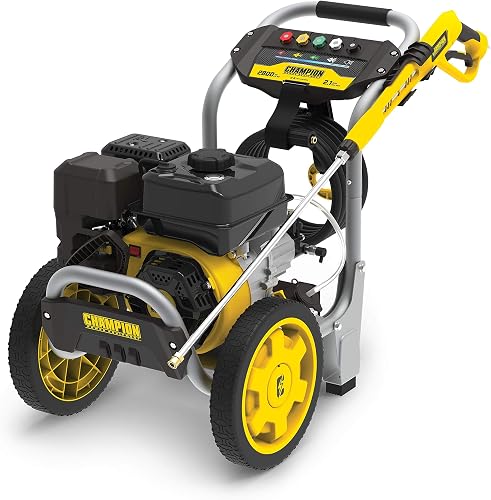
- 2800 PSI and 2.1 GPM
- Five quick-connect nozzles
- Onboard detergent tank
- Onboard hose and wand storage
The onboard detergent tank and storage for the hose, gun and wand help keep the setup together between jobs.
Pros
- Onboard detergent tank
- Onboard accessory storage
- Lifetime technical support
Cons
- Lowest pressure and flow in this group
- Hose length details conflict
The Champion 2800 PSI Low Profile has the lowest stated output in the group at 2800 PSI and 2.1 GPM. It includes an onboard 1-gallon detergent tank and storage for the hose, trigger gun and wand.
Its five nozzles cover 0°, 15°, 25°, 40° and soap. Champion includes a 2-year limited warranty and lifetime technical support.
Hose length details conflict: the product name and description say 25 ft, while the specifications say 41.5 in. Confirm the hose length and package details before choosing it for jobs that need extra reach.
How do you choose a gas pressure washer for home projects?
Choose based on the surfaces you clean most, then compare pressure, flow and nozzle choices. More pressure does not automatically make a washer the right fit for every material or task.
What pressure and flow should the best gas pressure washer have?
For many homeowners, models around 2800 to 3400 PSI offer a range of options for outdoor cleaning. Flow rate matters too because it describes how much water the pump moves, so compare both numbers instead of shopping by PSI alone.
Our guide to pressure washer GPM vs PSI explains how the two figures affect cleaning. For patios and concrete, see our driveway pressure washer picks.
Which nozzle set suits a gas pressure washer?
A range of nozzle angles gives you more ways to adjust the spray. Start with a wider spray and greater distance, then test a hidden spot before cleaning the main surface.
The 0° nozzle creates a concentrated stream that can damage materials. Avoid it on surfaces that may be harmed by intense pressure, and follow the washer manual for safe nozzle use.
How much hose reach do you need?
A longer hose can help you reach around a vehicle or across a patio without moving the washer as often. It still needs safe routing, and you should keep it clear of hot engine parts and foot traffic.
Most picks here include a 25 ft hose. The WPX3600 has a 35 ft hose, while the VEVOR has a 26 ft hose.
What should you know before starting a gas washer?
Gas models need fuel and engine care, and they should be used outdoors according to the manufacturer's safety instructions. Before the first use, follow the manual for oil, fuel, water supply and starting steps.
Our beginner's guide to starting a gas pressure washer walks through setup. Keep the manual with the machine so you can check its specific procedure and maintenance schedule.
How should you set up and use a gas pressure washer?
Set up on stable ground, connect the water supply before starting, and select a nozzle that suits the surface. Read the manual first because engine, fuel and pump procedures can differ between models.
Check that hose connections are secure and the inlet has a steady water supply. Start the engine using the model's instructions, then squeeze the trigger as directed to clear air from the line before cleaning.
Keep the spray moving and begin with a wide-angle tip at a distance from the surface. Move closer gradually only if needed, and stop if paint lifts, wood fibers rise or water enters gaps.
Use detergent only with the nozzle and method specified for the washer. Rinse according to the detergent directions, and keep the spray away from people, pets, electrical equipment and fragile materials.
Which gas pressure washer mistakes should you avoid?
The most common mistakes are using too narrow a spray, starting too close, running the pump without water and ignoring the engine manual. Each can damage a surface or the equipment.
Do not treat the highest PSI as the best setting for every job. A 0° tip can concentrate force in a small area, so use a wider pattern for delicate surfaces and test a hidden area first.
Do not start the engine before connecting the water and following the model's setup steps. Avoid leaving the washer running with the trigger released longer than the manual allows, since pump heat can build up.
Do not assume detergent can go through every nozzle or that every soap is safe for every surface. Use the specified detergent setup, follow dilution directions and rinse plants or nearby areas as appropriate.
How do you care for a gas pressure washer between jobs?
Care for the engine and pump according to the manual, and store the washer with its hoses and accessories protected. Regular checks help you catch leaks, loose fittings and fuel issues before the next job.
After use, shut down in the order the manual specifies, relieve pressure from the hose and disconnect the water. Drain or store detergent as directed so residue does not remain in the tank or siphon system.
Check engine oil and air-filter service intervals in the manual, and use the fuel type it specifies. If the washer will sit through cold weather, follow a winter storage procedure; our guide to winterizing a pressure washer covers the key steps.
Which gas pressure washer should you choose?
Choose the WPX3400 for a broad mix of home jobs, five nozzles and onboard soap. Pick the DeWalt if its warranty terms and 49-state eligibility fit your needs, or the WPX3600 if its longer hose helps you cover larger areas.
The best gas pressure washer for your home is the one whose output, hose reach and maintenance needs match the work you actually plan to do. If most jobs are light and close to an outlet, compare the trade-offs in our electric vs gas pressure washer guide.
Westinghouse WPX3400 Gas: Best for everyday home projects
- 3400 PSI and 2.6 GPM
- 25 ft hose
- Five quick-connect nozzles
- Onboard soap tank
Pressure, flow, five nozzle options and onboard detergent storage make this a flexible choice for varied home cleaning.
Pros
- Five nozzle options
- Onboard soap tank
- 3-year limited manufacturer coverage
Cons
- Recoil start
- Gas engine needs fuel and routine care
Westinghouse WPX3200 Gas: Best for patio routines
- 3200 PSI and 2.5 GPM
- 25 ft hose
- Five quick-connect nozzles
- Half-gallon onboard soap tank
It has five nozzle options and an onboard soap tank, with slightly lower pressure and flow than the WPX3400.
Pros
- Five nozzle options
- Onboard soap tank
- 3-year limited manufacturer coverage
Cons
- Recoil start
- Less pressure and flow than the WPX3400
DeWalt DXPW3300-S: Best for warranty priorities
- 3300 PSI and 2.4 GPM
- 25 ft hose
- Five quick-connect nozzles
- 5-year frame warranty
Its 5-year frame, 3-year pump and 2-year engine warranties stand out among these picks, alongside a five-nozzle set.
Pros
- Long frame warranty
- 208 cc DeWalt engine
- Five nozzle options
Cons
- 49-state compliant
- No onboard soap tank specified
Simpson Clean Machine 3400: Best for uneven yards
- 3400 PSI and 2.5 GPM
- 25 ft hose
- Four quick-connect nozzles
- 10 in pneumatic tires
Its pneumatic tires are designed to roll over gravel, grass and curbs, useful when moving between outdoor work areas.
Pros
- Pneumatic tires
- Low-oil shutdown
- Maintenance-free axial cam pump
Cons
- Four nozzles
- 49-state compliant, not for sale in California
Westinghouse WPX3000 Gas: Best for detergent buckets
- 3000 PSI and 2.3 GPM
- 25 ft hose
- Four quick-connect nozzles
- Detergent siphon hose
This lower-output option has a detergent siphon hose and four nozzle angles for homeowners who want a simpler setup.
Pros
- Detergent siphon hose
- Never-flat wheels
- 3-year limited manufacturer coverage
Cons
- Four nozzles
- Lower pressure and flow than higher-ranked picks
Westinghouse WPX3600 Gas: Best for wide driveways
- 3600 PSI and 2.7 GPM
- 35 ft hose
- Five quick-connect nozzles
- Triplex brass head pump
Its 35 ft hose is the longest in this group, and its stated pressure and flow are the highest.
Pros
- Longest hose here
- Five nozzle options
- Triplex brass head pump
Cons
- Heavier than several picks at 79 lb
- Higher output may exceed some home needs
VEVOR 3400 PSI Gas: Best for tidy storage
- 3400 PSI and 2.6 GPM
- 26 ft hose
- Five quick-connect nozzles
- Accessory storage on machine
A 26 ft abrasion-resistant hose and on-machine accessory storage help keep the included parts together.
Pros
- Five nozzle options
- Accessory storage on machine
- Aluminum pump
Cons
- Confirm warranty and support terms before buying
- Recoil start
Simpson Clean Machine 2900: Best for lighter lifting
- 2900 PSI and 2.4 GPM
- 25 ft hose
- Four quick-connect nozzles
- 50 lb
At 50 lb, this is the lightest listed pick and offers lower output for routine household cleaning.
Pros
- Lowest weight among listed picks
- Never-flat wheels
- Siphon hose for external detergent
Cons
- Four nozzles
- 49-state compliant, not for sale in California
Champion 2800 PSI Low Profile: Best for organized garages
- 2800 PSI and 2.1 GPM
- Five quick-connect nozzles
- Onboard detergent tank
- Onboard hose and wand storage
The onboard detergent tank and storage for the hose, gun and wand help keep the setup together between jobs.
Pros
- Onboard detergent tank
- Onboard accessory storage
- Lifetime technical support
Cons
- Lowest pressure and flow in this group
- Hose length details conflict
Our top 3 picks at a glance
-
1
-
2
-
3
Frequently asked questions
What is a good PSI for a gas pressure washer?
For many home jobs, a gas pressure washer in the 2800 to 3400 PSI range offers several options. The surface, nozzle and distance affect how forceful the spray is, so start with a wider spray and test an inconspicuous area.
Use extra care around wood, paint, siding and other surfaces that can be damaged.
Is higher PSI always better for home use?
No. Higher pressure can remove grime faster from durable surfaces, but it can also damage softer materials or force water into gaps.
Choose a nozzle and working distance that fit the surface, and follow the washer manual.
A wider spray and a test spot give you more control.
Do gas pressure washers need an outdoor water connection?
Yes. A gas engine powers the pump, but the washer still needs a water supply connected to its inlet.
Check the manual for required supply flow and connection details before starting.
Never run the pump without water unless the manufacturer says that setup is safe.
What should you check before buying a gas pressure washer?
Compare pressure and flow, hose length, nozzle set, detergent setup, wheel type, weight and warranty. Consider where you'll store fuel and the washer, and whether recoil starting and engine care fit your routine.
Check local rules for gas equipment and emissions before you buy.


