9 Best Pressure Washer Surface Cleaners (October 2026)
The best pressure washer surface cleaners include the MEKOH 20-Inch Surface Cleaner for large driveways, the Westinghouse 16.5-Inch Surface Cleaner for stainless steel, and the WOJET 20-Inch Surface Cleaner for powerful washers.
On this page (8 sections)
- How we chose the best pressure washer surface cleaners
- The best pressure washer surface cleaners for different jobs
- How do you choose the best pressure washer surface cleaner for your setup?
- How do you set up a pressure washer surface cleaner?
- How should you use and care for a surface cleaner?
- Can you use a pressure washer surface cleaner on a deck?
- What mistakes should you avoid with a surface cleaner?
- Which pressure washer surface cleaner should you choose?
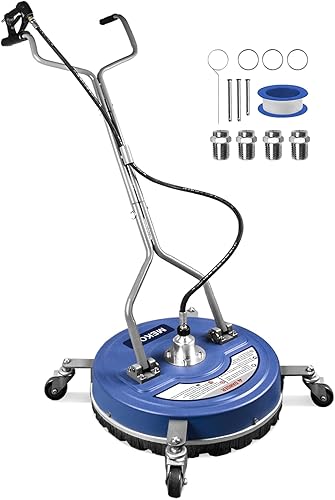
The MEKOH 20-Inch Surface Cleaner is our top choice for broad driveways and patios, with four wheels, two adjustable handles and a 20-inch cleaning width. If you searched for the best pressure washer surface cleaner, start by matching the head to your washer's output and the size of the area you clean.
A surface cleaner holds spinning pressure jets beneath a housing, keeping them at a steady height over the ground. That setup can cover a wider strip than a single spray wand and helps reduce uneven marks when you move at a controlled pace.
These attachments need a pressure washer to operate. They do not connect directly to a standard garden hose, and the cleaner must match your washer's pressure, water flow and fitting.
For operating steps and safe setup, see our guide to using a pressure washer surface cleaner. If you are still choosing the machine itself, start with our pressure washer guide for homeowners.
Our picks at a glance
-
1
-
2

-
3

- 4
 Check it
WOJET 18-Inch High Flow Surface Cleaner
Best for high flow - 5
 Check it
Biswing 18-Inch Surface Cleaner
Best for wand extensions - 6
 Check it
Kärcher 15-Inch Surface Cleaner
Best for narrow paths - 7
 Check it
Simpson 16.5-Inch Surface Cleaner
Best for cold-water washers - 8
 Check it
Ridge Washer 18-Inch Surface Cleaner
Best for high-flow jobs - 9
 Best for mixed connectorsCheck it
How we chose the best pressure washer surface cleaners
The picks below cover a range of head widths, fittings, pressure and flow limits, wheel layouts and included maintenance tools. Each product suits a different setup, so washer compatibility matters as much as the cleaner's size.
A wider head can cover more ground per pass, but it needs a washer that can supply its jets. If you're choosing both pieces of equipment, our driveway pressure washer guide can help you match a washer to the job.
| Product | Best for | Width | Connection | Washer needs | Our score |
|---|---|---|---|---|---|
| MEKOH 20-Inch Surface Cleaner | large driveways | 20 in | 3/8 in quick connect | 2,000+ PSI and 2+ GPM | 8.7 |
| Westinghouse 16.5-Inch Surface Cleaner | stainless steel | 16.5 in | 1/4 in quick connect | 8.6 | |
| WOJET 20-Inch Surface Cleaner | powerful washers | 20 in | 3/8 in quick plug | 8.4 | |
| WOJET 18-Inch High Flow Surface Cleaner | high flow | 18 in | 3/8 in quick plug | 8.2 | |
| Biswing 18-Inch Surface Cleaner | wand extensions | 18 in | 1/4 in quick plug | At least 2,000 PSI and 1.8 GPM | 8.1 |
| Kärcher 15-Inch Surface Cleaner | narrow paths | 15 in | 1/4 in quick connect | 8.0 | |
| Simpson 16.5-Inch Surface Cleaner | cold-water washers | 16.5 in | 1/4 in quick connect | 7.9 | |
| Ridge Washer 18-Inch Surface Cleaner | high-flow jobs | 18 in | Not specified | 7.7 | |
| VEVOR 18-Inch Surface Cleaner | mixed connectors | 18 in | 3/8 in quick connect with 1/4 in adapter kit | 7.6 |
The best pressure washer surface cleaners for different jobs
The best fit depends on the area you plan to clean and the washer you already own. These picks are ordered by score, with each one suited to a distinct combination of size, connection and flow needs.
MEKOH 20-Inch Surface Cleaner: Best for large driveways
- 20 in cleaning width
- Four wheels and two adjustable handles
- 3/8 in quick connect
- Works with washers rated 2,000 PSI or higher and 2 GPM or higher
A 20-inch head, four casters and two adjustable handles suit broad driveways and patios. MEKOH says to use a washer rated at least 2,000 PSI and 2 GPM, with better results at 3,400 PSI or higher.
Pros
- Wide 20 in cleaning path
- Four wheels and two adjustable handles
- Changeable nozzles
Cons
- Needs a compatible pressure washer
- Large head may be awkward in tight areas
The MEKOH has the widest head in this group at 20 inches, with four casters and two angle-adjustable handles. The wheeled, two-hand layout suits long passes across open driveways, sidewalks and patios.
MEKOH specifies a washer rated at least 2,000 PSI and 2 GPM, and recommends 3,400 PSI or higher for better results. The attachment is not for a garden hose, so confirm the pressure washer and hose setup before connecting it.
Changeable nozzles allow different cleaning patterns, and the package includes extra attachments and an operation manual. The head may be awkward to steer through tight corners or narrow paths.
Choose it for broad hard surfaces and a washer that meets its requirements. Skip it if most of your cleaning is in confined spaces where a smaller head is easier to guide.
Westinghouse 16.5-Inch Surface Cleaner: Best for stainless steel
- 16.5 in cleaning width
- Stainless steel construction
- 1/4 in quick connect
- Rated up to 4,400 PSI
The stainless steel shroud and 16.5-inch width suit buyers seeking a mid-size cleaner. Its 1/4-inch quick connect fits many gas and electric pressure washers.
Pros
- Stainless steel construction
- 1/4 in quick-connect fitting
- Westinghouse provides a 180-day limited warranty
Cons
- Confirm your washer's connector and pressure first
- Wider than compact heads for narrow areas
Westinghouse offers a 16.5-inch stainless steel head rated up to 4,400 PSI. Its 1/4-inch quick-connect fitting works with many gas and electric pressure washers.
This mid-size option can suit a mix of patio, walkway and driveway cleaning when you want a durable stainless steel shroud without a 20-inch head. Westinghouse backs it with a 180-day limited warranty.
Choose it if stainless steel and a 1/4-inch fitting suit your washer. Check the gun or wand connection before buying, and skip it if you need an especially narrow head for confined spaces.
WOJET 20-Inch Surface Cleaner: Best for powerful washers
- 20 in cleaning width
- Four wheels and two handles
- 3/8 in quick plug
- Rated up to 4,500 PSI and 4 GPM
WOJET pairs a 20-inch head with four wheels and dual handles for broad flat areas. Its stated washer requirement starts at 2,000 PSI and 2 GPM.
Pros
- Large cleaning width
- Four wheels and dual handles
- Includes replacement nozzles and a nozzle cleaner
Cons
- Requires a compatible washer
- Check that the 3/8 in connection matches your hose
The WOJET 20-Inch combines a wide cleaning path with four wheels and dual handles. It has a 3/8-inch quick plug and maximum ratings of 4,500 PSI and 4 GPM.
WOJET says the cleaner needs a washer above 2,000 PSI and 2 GPM. The package includes two replacement nozzles, a nozzle cleaner and assembly tools.
This is a fit for broad concrete, brick or other flat areas when your washer and hose use the matching connection. A 20-inch head can be cumbersome around tight corners, so consider a smaller width if access is limited.
Choose it for wide open surfaces and compatible washer output. Skip it if your washer cannot supply the required flow or the hose connection does not match.
WOJET 18-Inch High Flow Surface Cleaner: Best for high flow
- 18 in cleaning width
- Four wheels and dual handles
- 3/8 in quick plug
- Rated up to 4,500 PSI and 5 GPM
This 18-inch WOJET model is aimed at higher-flow setups. Its dual 2.5 GPM nozzles and 5 GPM maximum flow call for checking the washer's output before buying.
Pros
- 5 GPM maximum flow rating
- Four wheels and dual handles
- Includes replacement nozzles and a nozzle cleaner
Cons
- Needs a washer that can supply the flow
- Check connector fit before use
This WOJET pairs an 18-inch head with a 5 GPM maximum flow rating. Its four wheels and dual handles make it a push-style cleaner for patios, sidewalks and other flat areas.
The stated maximums are 4,500 PSI and 5 GPM, and the washer requirement starts above 2,000 PSI and 2 GPM. Compare the washer's actual output with those figures before choosing this model.
The package includes replacement nozzles and a nozzle cleaner. Its 3/8-inch quick plug must also match your hose or work with a suitable adapter.
Choose it for a higher-flow washer and an 18-inch head. Skip it if your machine's flow falls short, even if its PSI rating appears high enough.
Biswing 18-Inch Surface Cleaner: Best for wand extensions
- 18 in cleaning width
- Four wheels
- 1/4 in quick plug
- Includes two 17 in extension wands
The Biswing includes two extension wands, replacement nozzles and a nozzle cleaner. It suits buyers whose pressure washer gun accepts a 1/4-inch quick-connect fitting.
Pros
- Two extension wands included
- Four wheels
- Minimum washer flow of 1.8 GPM
Cons
- May need a separate adapter for some guns
- Not for garden hoses
Biswing includes two 17-inch extension wands with its 18-inch cleaner. The 1/4-inch quick plug connects to compatible guns and wands, while four wheels help it move over flat surfaces.
Its minimum requirement is 2,000 PSI and 1.8 GPM, with a maximum flow of 3.7 GPM and working pressure up to 4,000 PSI. The package also includes replacement nozzles, seal tape, O-rings and a nozzle cleaner.
Some guns may need a separate adapter, so check the connection before use. The cleaner is not for a garden hose.
Choose it if the included extensions suit your setup and the 1/4-inch fitting matches. Skip it if your gun needs an adapter you cannot confirm.
Kärcher 15-Inch Surface Cleaner: Best for narrow paths
- 15 in cleaning width
- Three wheels
- Stainless steel shroud and splash-free skirt
- Rated for washers from 2,600 to 4,000 PSI
A 15-inch head and three wheels can be easier to steer across smaller patios and sidewalks than wider models. Kärcher specifies compatibility with washers rated from 2,600 to 4,000 PSI.
Pros
- Compact width for tighter flat areas
- Stainless steel shroud and splash-free skirt
- Includes two extension wands
Cons
- Check the washer's pressure range
- Three wheels instead of four
The Kärcher's 15-inch cleaning width is the smallest in this roundup. Three wheels and a splash-free skirt can make it easier to guide on sidewalks and patios near walls or plants.
Kärcher specifies compatibility with washers rated from 2,600 to 4,000 PSI and a standard 1/4-inch quick-connect fitting. Two spinning nozzles sit under a metal shroud, and two extension wands are included.
A compact head means more passes across a large driveway, but it can be easier to steer in tighter spaces. The specified pressure range starts above 2,000 PSI, so check your washer before buying.
Choose it for small hard surfaces and narrower paths. Skip it if you want the broadest coverage for a large open driveway.
Simpson 16.5-Inch Surface Cleaner: Best for cold-water washers
- 16.5 in cleaning width
- Stainless steel shroud and nozzles
- 1/4 in quick connect
- For cold-water washers from 2,000 to 4,000 PSI
Simpson's mid-size stainless steel cleaner suits a compatible cold-water pressure washer. The stated range starts at 2,000 PSI and 2.5 GPM, and tops out at 4,000 PSI and 4 GPM.
Pros
- Stainless steel shroud and nozzles
- Nozzle cleaning tool included
- 1/4 in quick connect
Cons
- Cold-water use only
- Check both PSI and GPM compatibility
Simpson's 16.5-inch cleaner has a stainless steel shroud and nozzles with a 1/4-inch quick connect. It is designed for cold-water washers from 2,000 to 4,000 PSI and 2.5 to 4 GPM.
A nozzle cleaning tool is included to clear buildup. Simpson recommends a slow, steady pace and light pressure to keep the cleaner at an even distance from the ground.
The flow range is specific, so compare both PSI and GPM with your washer. The cold-water-only limit rules it out if you plan to use a hot-water machine.
Choose it for a compatible cold-water washer and mid-size stainless steel head. Skip it if your washer's flow is outside the stated range.
Ridge Washer 18-Inch Surface Cleaner: Best for high-flow jobs
- 18 in cleaning width
- Four wheels and adjustable dual handle
- Up to 6.6 GPM
- Maximum pressure of 4,500 PSI
The Ridge Washer combines an 18-inch head, dual handle and four wheels with a high maximum flow rating. Confirm its connection and your washer's output before choosing it.
Pros
- Four wheels and adjustable dual handle
- Maximum flow rating of 6.6 GPM
- Rated up to 4,500 PSI
Cons
- Connection type needs confirmation
- High flow rating may not suit a home washer
Ridge Washer combines an 18-inch width, four wheels and an adjustable dual handle. It has a maximum pressure of 4,500 PSI and maximum flow of 6.6 GPM.
The high flow ceiling makes it a specialized choice, and the connector type needs confirmation before buying. Ask whether the fitting works with your hose and check that your washer can supply the flow you intend to use.
Choose it for a high-flow setup after confirming the connection. Most buyers with a lower-flow home washer should skip it and choose a model with requirements that match their machine.
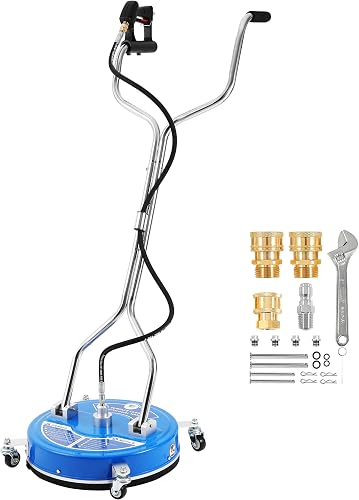
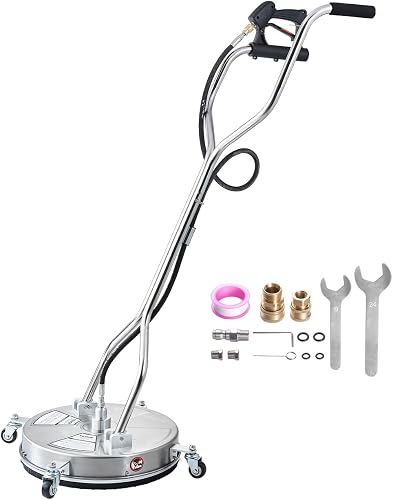
VEVOR 18-Inch Surface Cleaner: Best for mixed connectors
- 18 in cleaning width
- Four wheels and dual handle
- 3/8 in quick connect
- Includes a 1/4 in adapter kit
VEVOR includes a 1/4-inch adapter kit with its 3/8-inch quick connect. Its 18-inch head, four wheels and dual handle suit medium to large flat areas.
Pros
- Adapter kit included
- Four wheels and dual handle
- Nozzle-clearing needle included
Cons
- Rated maximum pressure is 4,000 PSI
- Check washer compatibility and connector fit
VEVOR offers an 18-inch head with four wheels and a dual handle. The cleaner has a 3/8-inch quick connect and includes a 1/4-inch adapter kit.
Its maximum ratings are 4,000 PSI and 4 GPM. VEVOR also includes a through-hole needle for clearing clogs.
The adapter kit may help with some setups, but it does not replace checking the pressure washer's output or the fitting on your gun. Match those details before connecting the cleaner.
Choose it if the adapter kit suits your connector and you want an 18-inch head. Skip it if your washer exceeds its maximum ratings or needs a different fitting.
How do you choose the best pressure washer surface cleaner for your setup?
Choose a cleaner by matching the head width, connector, PSI and GPM to the area and pressure washer you have. A wide head can make broad passes more efficient, while a smaller one is easier to steer through narrow sections.
Which width suits your pressure washer surface cleaner job?
A 20-inch head covers a wider strip per pass than a 15-inch head, so it can suit large, open driveways and patios. A 15- or 16.5-inch model may be easier to turn along narrow walkways or around patio edges.
The washer's output limits the practical benefit of extra width. If the machine cannot supply enough pressure and flow, moving to a wider head will not make the setup a better fit.
Measure gates, storage space and the narrowest part of the area before choosing. A cleaner that fits the main driveway but cannot pass through an access gate can add effort instead of saving it.
How should PSI and GPM guide the choice?
Check PSI and GPM together because a cleaner can have a separate limit or minimum for each. The WOJET high-flow model has a 5 GPM maximum flow rating, while Simpson specifies a range from 2.5 to 4 GPM.
Use the cleaner's stated range, not only your washer's headline PSI. Our pressure washer GPM and PSI guide explains how the two ratings affect cleaning.
A high PSI number alone is not a reason to buy a high-flow attachment. Compare the washer's rated flow with the cleaner's needs and maximums, and choose a model that fits both.
What connector does a pressure washer surface cleaner need?
The products here use either 1/4-inch or 3/8-inch quick-connect fittings. Compare the connector on the cleaner with the end of your gun, wand or hose, and confirm whether an adapter is included or needed.
Don't assume two quick connects fit just because they look similar. The Biswing may need a separate adapter for some guns, VEVOR includes a 1/4-inch adapter kit with a 3/8-inch connection, and the Ridge Washer connection needs confirmation.
Never connect a surface cleaner directly to a standard garden hose. These attachments use a pressure washer to power the spinning jets.
Which features matter for comfort and care?
Wheels and handles can make it easier to guide a cleaner over a broad surface. The MEKOH and WOJET 20-inch models have four wheels and dual handles, while the Kärcher 15-inch uses three wheels.
Included maintenance tools can also matter if you want a nozzle cleaner or replacement nozzles on hand. Biswing and both WOJET picks include replacement nozzles and cleaning tools, while VEVOR includes a through-hole needle to clear clogs.
How do you set up a pressure washer surface cleaner?
Set up the cleaner by checking the manual, confirming the fitting and ratings, and making sure the attachment is fully connected before starting. A loose connection can release under pressure, so verify that it is seated and secure.
First, check that the washer is off and pressure is relieved before connecting or changing attachments. Match the connector and any adapter to the gun or hose, then follow the cleaner's assembly instructions.
Before starting, inspect the housing, wheels, handles and nozzles for visible damage or debris. Keep people, pets and fragile items away from the work area, and use the protective equipment recommended in your washer manual.
Start the washer according to its instructions and bring the cleaner onto the surface with control. Keep it level, move at a steady pace and avoid lifting or tilting the housing while the jets are running.
For step-by-step operating guidance, read our pressure washer surface cleaner use guide. If you are new to the machine, our beginner's guide to using a pressure washer covers basic setup and handling.
How should you use and care for a surface cleaner?
Use smooth, even passes and inspect the finish as you go. A surface cleaner can reduce the back-and-forth of a spray wand, but it still needs a suitable pace and clear nozzles for even coverage.
Start with the cleaner flat on the surface, then move slowly enough for the jets to remove dirt. Overlap each pass slightly to reduce untreated lines, and avoid stopping in one spot while the jets are running.
After use, switch off and disconnect the washer according to its manual, then relieve pressure before inspecting the attachment. Rinse away loose dirt and check the nozzles for buildup; use the supplied nozzle tool or needle when the product includes one.
Store the cleaner where its housing, connectors and wheels are protected from damage. Follow the maker's care instructions, and check the washer manual for cold-water limits or other operating requirements.
Can you use a pressure washer surface cleaner on a deck?
Some cleaners are described for deck use, but the attachment does not make high-pressure washing safe for every wood surface. Wood type, finish and condition affect how it responds to pressure.
Follow the deck maker's care advice, start with a low-pressure setting and try a hidden spot first. Keep the cleaner moving and stop if the surface changes or the finish lifts.
Our guide to pressure washing a wood deck covers setup and technique. For concrete, see our driveway washing guide.
What mistakes should you avoid with a surface cleaner?
The most common mistakes are mismatching the washer, moving too quickly, using the wrong connector and letting a nozzle clog. Each can lead to poor coverage, interruption or an unsafe connection.
- Choosing by PSI alone: Check GPM as well as pressure, and stay within the cleaner's stated range.
- Buying a head that's too wide: Consider the washer output, access gates, turns and storage space.
- Guessing at the fitting: Confirm whether the setup uses a 1/4-inch or 3/8-inch connection and whether an adapter is needed.
- Moving too quickly: Use a slow, steady pace and overlap passes so the whole surface gets consistent coverage.
- Ignoring stripes: Stop and inspect the nozzles for clogs, then recheck washer compatibility and your pace.
- Using a garden hose: A surface cleaner needs a compatible pressure washer to operate.
- Using it on delicate material without checking: Follow the surface maker's care guidance and try a hidden area first.
Which pressure washer surface cleaner should you choose?
Choose the MEKOH 20-Inch for broad driveways and patios if your washer meets its pressure and flow needs. Pick the Kärcher 15-Inch for smaller areas and easier steering, or the WOJET 18-Inch High Flow when your washer can supply its higher flow demand.
For a mid-size stainless steel head, compare the Westinghouse and Simpson options, then match the connector and washer limits. Before you buy the best pressure washer surface cleaner for your setup, verify PSI, GPM and fitting compatibility, then follow our surface cleaner use guide for even passes.
Our top 3 picks at a glance
-
1
-
2
-
3
Frequently asked questions
What size pressure washer surface cleaner should I buy?
Choose a head width that fits the area and your washer's output. A wider cleaner covers more ground per pass, but it needs enough pressure and water flow to drive its nozzles.
For narrow paths and smaller patios, a 15- or 16.5-inch model can be easier to steer than a 20-inch head.
Will a surface cleaner fit any pressure washer?
No. Check the cleaner's connector, pressure range and flow needs against your washer and gun.
The products here use either 1/4-inch or 3/8-inch quick connects, and some require a compatible adapter.
A surface cleaner needs a pressure washer.
It does not run from a standard garden hose.
Is a higher GPM pressure washer better for a surface cleaner?
A surface cleaner needs enough water flow as well as pressure. Match its GPM requirement to your washer's output; a high-flow model may not work well with a lower-flow washer.
Our pressure washer GPM vs PSI guide explains how the two ratings affect cleaning.
Can I use a surface cleaner on a wood deck?
Some cleaners are described for decks, but the attachment does not make high-pressure washing safe for every wood surface. Use the deck maker's care guidance, start with a low-pressure setting, and test a hidden spot first.
Our wood deck pressure washing guide covers safer setup and technique.
How do I avoid stripes with a surface cleaner?
Keep a steady pace and overlap each pass slightly so missed strips are less likely. Simpson recommends a slow, steady pace with light pressure to maintain an even distance from the ground.
If streaks remain, inspect the nozzles for clogs and check that your washer meets the cleaner's pressure and flow needs.


