9 Best Pressure Washers for Home Use (October 2026)
The best pressure washers for home use include the Westinghouse ePX3100 for tight storage, the Westinghouse WPX2700 Gas for larger yards, and the Westinghouse WPX3200e for distant outlets.
On this page (7 sections)
- Which pressure washer is best for home use?
- How should you compare pressure washers for home use?
- What should you check before choosing a home pressure washer?
- How do you set up and use a home pressure washer?
- What mistakes should you avoid with a home pressure washer?
- How do you care for a pressure washer between jobs?
- Which pressure washer for home use should you choose?
The best pressure washer for home use depends on the surfaces you clean, the size of the area and access to power. The Westinghouse ePX3100 is a compact electric choice for everyday jobs; the WPX2700 Gas and Simpson Clean Machine suit larger tasks where higher water flow matters.
A useful home washer should fit your work pattern as well as your cleaning list. Think about where it will sit, how far the hose and cord must reach, and whether you are comfortable storing and maintaining gas equipment.
We compared pressure, flow, reach, nozzles, detergent features and portability across nine models. The picks below cover compact storage, electric reach, accessory compatibility and higher-flow gas power.
For a plain overview of power types and tradeoffs, see our pressure washers for homeowners buyer's guide. If you know you want electric, compare our best electric pressure washers.
Our picks at a glance
-
1

-
2

-
3

Which pressure washer is best for home use?
The Westinghouse ePX3100 is the best fit for many homes because it pairs compact storage with useful mobility and a soap tank. Choose one of the gas models when your work area is broad and higher water flow matters more than corded operation.
Westinghouse ePX3100: Best for tight storage
- 1900 rated PSI
- 1.24 rated GPM
- 19 lb
- 25 ft hose
- Four steering wheels
A compact electric washer with four steering wheels, an onboard soap tank and a 25 ft hose. Its rated pressure and flow suit a range of home cleaning tasks.
Pros
- Compact 19 lb design
- Four 360-degree steering wheels
- Onboard soap tank
Cons
- Lower rated flow than the gas picks
- Corded electric power
The ePX3100 suits homeowners who want a small, easy-to-move machine for routine outdoor jobs. Its 19 lb weight and four wheels with 360-degree steering make it convenient to reposition around a driveway or patio.
Westinghouse gives it 1900 rated PSI and 1.24 rated GPM. The rated figures are the useful comparison points here; the higher maximum figures describe peak output.
A 25 ft hose, five quick-connect nozzles and a 20 oz soap tank give you options for cars, fences, driveways and patio furniture. The pump stops when you release the trigger.
Choose it if you have limited storage, value easy movement or mostly clean smaller areas. Skip it if you need the higher flow of a gas machine for repeated work across large paved spaces.
Westinghouse WPX2700 Gas: Best for larger yards
- 2700 PSI
- 2.3 GPM
- 25 ft hose
- Five quick-connect nozzles
- Onboard soap tank
This gas washer pairs 2700 PSI with 2.3 GPM for homeowners who want more water flow. It includes a soap tank and five nozzles.
Pros
- Higher flow than the electric picks
- Five quick-connect nozzles
- Never-flat wheels
Cons
- Gas engine needs fuel and maintenance
- Heavier than the electric picks
The WPX2700 Gas is a sensible choice for homeowners with broad outdoor areas who want more flow than the electric picks provide. It delivers 2.3 GPM at 2700 PSI, with a 25 ft hose for working around a driveway, fence or patio.
Its five quick-connect nozzles include 0°, 15°, 25°, 40° and soap tips. A half-gallon soap tank gives you a way to apply detergent, and never-flat wheels help move it across outdoor surfaces.
A gas engine requires fuel and routine engine care. At 28.6 kg, this is also a heavier machine to store and move than the compact electric pick.
Choose it when higher flow and freedom from a power cord justify the engine upkeep. Skip it if you want a lightweight washer that can be stored in a small space or used close to the house without gas equipment.
Westinghouse WPX3200e: Best for distant outlets
- 2800 rated PSI
- 1.1 rated GPM
- 35 ft power cord
- 25 ft hose
- Onboard soap tank
A corded electric option with a 35 ft power cord, 25 ft hose, steel frame and onboard soap tank. Check the rated figures alongside the higher maximum pressure.
Pros
- 35 ft power cord
- 25 ft hose
- Steel frame with never-flat wheels
Cons
- Rated flow is 1.1 GPM
- Corded electric power
The WPX3200e suits homeowners who want electric power with a long cord and a wheeled frame. Its 35 ft cord and 25 ft hose can make placement easier when the outlet is some distance from the work area.
Westinghouse gives it 2800 rated PSI and 1.1 rated GPM, alongside 3200 max PSI and 1.76 max GPM. It also has five quick-connect nozzles, a .61 gallon soap tank and a steel frame with 10 in never-flat wheels.
Choose it if cord reach and a larger detergent tank are useful for your routine. Skip it if you value water flow most: its rated flow is lower than the gas picks, and it remains dependent on an outlet.
Westinghouse WPX2300e: Best for add-on tools

- 1900 rated PSI
- 1.2 rated GPM
- 35 ft GFCI cord
- M22 accessory compatibility
- Onboard soap tank
This electric washer accepts compatible M22 accessories such as surface cleaners and foam cannons. Its 35 ft GFCI cord can help extend reach from an outlet.
Pros
- M22 accessory compatibility
- 35 ft GFCI cord
- Five quick-connect nozzles
Cons
- Rated pressure is 1900 PSI
- Corded electric power
The WPX2300e is a good match for a homeowner who expects to add compatible accessories. Its M22 fittings work with compatible surface cleaners, undercarriage cleaners and foam cannons.
It supplies 1900 rated PSI and 1.2 rated GPM. A 35 ft GFCI cord, 25 ft hose, .42 gallon soap tank and five quick-connect nozzles round out its practical setup.
Choose it if accessory options matter and your jobs suit a corded electric washer. Skip it if you do not expect to use add-ons and would rather have the compact form of the ePX3100 or more flow from gas power.
Kärcher K1900PS: Best for foot controls

- 1900 PSI TruPressure
- 1.2 GPM
- On/off foot switch
- 20 ft hose
- Three nozzles
A CETA-certified electric washer with a foot switch, three nozzles and a detergent tank. Its shorter hose may suit smaller areas near the water source.
Pros
- Foot switch for on/off operation
- Three nozzles
- Fold-down handle
Cons
- 20 ft hose
- 1.2 GPM flow
The Kärcher K1900PS is a straightforward electric option for a smaller work area near a water source. It has 1900 PSI TruPressure, 1.2 GPM and an on/off foot switch, which lets you operate it without bending to reach a button.
Three nozzles cover 15-degree spray, turbo cleaning and soap application. The detergent tank holds 0.5 gallons, while its 20 ft hose is shorter than most other picks here.
Kärcher says this model is CETA certified. It also has never-flat wheels, a fold-down handle and storage for the gun, hose and wand.
Choose it if the foot switch and storage setup suit your routine. Skip it if you need a longer hose to move around a large property without repositioning the washer.
Sun Joe SPX3000-XT1: Best for accessory bundles
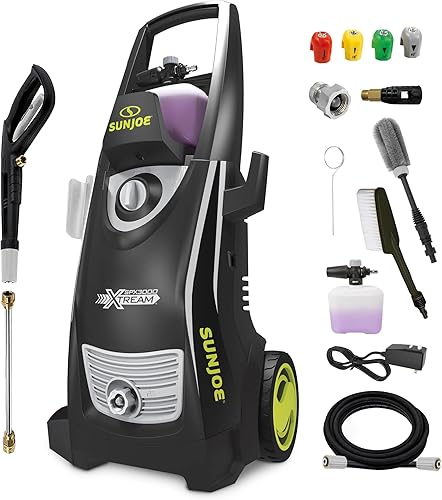
- 2200 PSI
- 1.65 GPM maximum flow
- 35 ft GFCI cord
- 20 ft hose
- Four spray tips
This electric model includes a 35 ft GFCI cord, a 20 ft hose and four spray tips. The listed 1.65 GPM is maximum flow, so compare it carefully with rated-flow figures.
Pros
- 35 ft GFCI power cord
- Four spray tips
- Soap applicator
Cons
- 20 ft hose
- Maximum flow figure is not a rated-flow figure
The Sun Joe SPX3000-XT1 fits homeowners who want a long power cord and several included cleaning accessories. Its 35 ft GFCI cord reaches farther from an outlet than its 20 ft high-pressure hose, so plan where the machine will sit before starting.
It has 2200 PSI and a maximum flow of 1.65 GPM. The kit includes four quick-connect tips, a soap applicator, a 34 in extension wand and a garden hose adapter.
Its shorter hose means you'll need to move the washer during some jobs. Don't stretch the hose or pull the machine by the cord to gain reach.
Choose it if the cord length and accessory set fit your layout. Skip it if you need a longer high-pressure hose or want rated flow figures for a direct comparison.
Simpson Clean Machine 3200: Best for high-flow cleaning

- 3200 PSI
- 2.5 GPM
- 25 ft hose
- Turbo nozzle
- 49-state compliant
A gas washer with 3200 PSI, 2.5 GPM, a turbo nozzle and an onboard soap tank. It is not for sale in California.
Pros
- 2.5 GPM flow
- Turbo nozzle included
- Never-flat wheels
Cons
- Gas engine needs fuel and maintenance
- Not for sale in California
The Simpson Clean Machine 3200 is the highest-flow pick here, with 3200 PSI and 2.5 GPM. Its gas engine, turbo nozzle and 25 ft hose suit homeowners handling large driveways, siding, decks and patio furniture.
Four quick-connect tips cover 0°, 15°, 40° and soap spray. The onboard soap tank applies detergent, and 12 in never-flat wheels help it roll over gravel, grass and curbs.
This machine weighs 50 lb and is not for sale in California. Its engine needs fuel and care, so factor in both the heavier frame and ongoing upkeep.
Choose it when high flow and the included turbo nozzle fit your larger jobs. Skip it if you live in California, prefer electric power or need a lighter machine to carry and store.
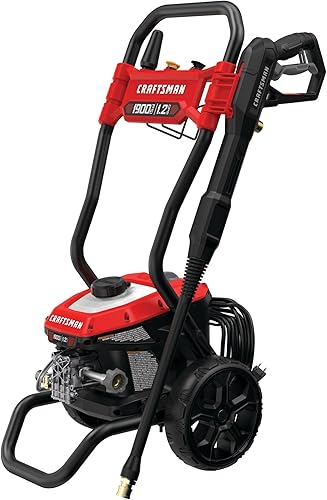
Craftsman CMEPW1900: Best for neat storage
- 1900 PSI
- 25 ft hose
- 35 ft power cord
- Onboard accessory storage
- Three nozzles
This electric washer has onboard storage for its hose, cord, wand and nozzles. Its 35 ft cord and 25 ft hose offer reach around the house.
Pros
- Onboard storage for accessories
- 35 ft power cord
- Kink-resistant hose
Cons
- 1900 PSI maximum pressure
- Corded electric power
The Craftsman CMEPW1900 is a practical fit for people who want accessories kept together between jobs. Onboard storage holds the hose, cord, wand and nozzles, making it easier to put the washer away without loose parts.
It has 1900 max PSI, a 25 ft kink-resistant hose and a 35 ft power cord. The integrated soap tank and three included nozzles give you options for washing a car or cleaning a patio.
Choose it if tidy storage and a long cord are priorities. Skip it if you need more pressure options: its included set has three nozzles, and it remains tethered to a power outlet.
Greenworks 2400 PSI: Best for nozzle choice

- 2400 PSI
- 1.2 GPM
- Five interchangeable nozzles
- 35 ft GFCI cord
- Detergent tank
A corded electric washer with five interchangeable nozzles, a detergent tank and onboard nozzle storage. Its 1.2 GPM flow is clearly stated alongside pressure.
Pros
- Five interchangeable nozzles
- 35 ft GFCI power cord
- Onboard nozzle storage
Cons
- 1.2 GPM flow
- Corded electric power
The Greenworks 2400 PSI stands out for homeowners who want several spray options in one electric machine. Its five interchangeable nozzles include 0°, 15°, 25°, turbo and soap tips.
It has 2400 PSI and 1.2 GPM, with a detergent tank and onboard nozzle storage. The 35 ft GFCI cord and 20 ft hose set its reach, so check both lengths against your outdoor layout.
Choose it if nozzle choice and corded electric power fit your cleaning list. Skip it if you want a higher-flow model for broad jobs or a hose that reaches farther before you move the machine.
How should you compare pressure washers for home use?
Compare rated pressure and flow where available, then check reach, nozzles, detergent features and portability. A high PSI maximum alone does not tell you how well a machine fits your surfaces or layout.
A washer's pressure and flow work together. Our guide to pressure washer GPM vs PSI explains why it's useful to read those figures as a pair, especially when one figure is a maximum and another is rated.
Electric models need an outlet, so cord length affects where you can work. Gas models offer higher flow in this group, but their engines need fuel and care.
We scored each model for its fit with common home jobs, taking its stated specs, features and practical setup into account. Our picks favor a useful match for the buyer, rather than the biggest number on the box.
What should you check before choosing a home pressure washer?
Start with the surface you clean most, the size of the work area, the distance to your outlet or fuel storage, and the room you have to store the machine. Then check its hose, cord, nozzle set and flow.
Is electric or gas the better pressure washer for home use?
Electric is a sensible fit for regular jobs near an outlet, such as patio furniture, fences, vehicles and smaller paved areas. Cord length and hose length both affect where you can work.
Gas suits larger areas or jobs where higher flow is useful. The WPX2700 Gas and Simpson Clean Machine both offer more flow than the electric options here, but their engines need fuel and upkeep.
For a closer comparison, read our electric vs gas pressure washer guide. If you're considering gas, our best gas pressure washers for homeowners roundup covers more options.
How much pressure and flow does the best pressure washer for home use need?
There is no single pressure and flow combination for every home. Cars, siding, wood decks and concrete have different needs, and a narrow spray can damage some surfaces if used too close.
A higher PSI figure does not automatically mean a faster or better result. Compare rated PSI and GPM when both are available, then use the nozzle and distance recommended for the surface.
See our guide to what size pressure washer you need to narrow your choice by job. For larger concrete areas, compare our best pressure washers for driveways and concrete.
How much hose and cord reach will you need?
Check hose and power cord lengths separately, because each connects to a different starting point. The cord must reach an outlet, while the hose must reach the work area from the washer.
Most picks here have a 25 ft hose; the Kärcher and Sun Joe have 20 ft hoses. The WPX3200e, WPX2300e, Sun Joe, Craftsman and Greenworks have 35 ft power cords.
Measure from the outlet and water source to the farthest point you plan to clean. Leave enough slack to move without tugging on the hose, cord or connections.
Which nozzle should you use on a house?
Use a wider spray for more delicate work and follow the pressure washer and surface maker's instructions. A narrow 0-degree tip concentrates force and can damage siding, wood, paint or seals when used too close.
The nozzle sets differ across these models, so match the included tips to your likely jobs. If you clean broad paved areas often, a compatible surface cleaner may help cover them more evenly.
Our guide to pressure washing a house without damage explains safer distance and spray technique. For driveways, see our guide to pressure washing concrete.
How do you set up and use a home pressure washer?
Set up the washer on stable ground, connect the garden hose and high-pressure hose, then clear air from the water line before you turn the machine on. Follow the model's instructions for connections, detergent and starting.
For an electric washer, use the specified outlet and keep cord connections away from standing water. For a gas washer, add the required engine oil if needed, check the fuel instructions and use it outdoors.
Start with the widest suitable nozzle and a test patch in an inconspicuous spot. Keep the spray moving, work from a safe distance, and move closer only if the surface tolerates it.
Apply detergent only when the washer and surface instructions allow it. Rinse thoroughly, avoid spraying directly into openings or electrical fixtures, and release pressure before changing a nozzle.
Read our beginner's guide to using a pressure washer for a step-by-step approach. If you need help starting a gas unit, see how to start a gas or electric pressure washer.
What mistakes should you avoid with a home pressure washer?
The most common mistake is starting too close with a narrow nozzle. That can strip paint, cut wood fibers, damage seals or force water behind siding before you have a chance to adjust.
Avoid using the 0-degree tip on delicate surfaces, and don't point any nozzle at people, pets or fragile objects. Keep the spray moving instead of holding it on one spot.
Don't use a surface cleaner or detergent unless it is compatible with your washer and the surface. Check fittings and hose connections before starting, and don't run the washer without its required water supply.
After use, switch off the machine and release pressure according to its instructions. Drain water as directed, store hoses without sharp bends, and protect the unit from freezing.
How do you care for a pressure washer between jobs?
Care depends on whether the machine is electric or gas, so follow the manual for pump, engine and storage steps. Keep the hose, nozzles and detergent tank clean, and check connections for leaks or damage before each use.
For gas models, follow the engine instructions for oil and fuel care. For electric models, keep the cord and plug in good condition and store them dry.
If freezing weather is expected, drain and protect the pump as the manual directs. Our pressure washer winterizing guide covers cold-weather storage.
Which pressure washer for home use should you choose?
Choose the ePX3100 for compact electric cleaning and easy storage, the WPX2700 Gas for higher flow across larger areas, or the WPX3200e when a long power cord matters most. Pick the WPX2300e if you expect to use compatible M22 accessories, and the Simpson Clean Machine if the highest flow in this group is your priority.
Before buying, match rated PSI and GPM to your work, check outlet and hose reach, and make sure you have room for the machine. Then read how to use a pressure washer safely before your first job.
Our top 3 picks at a glance
-
1
-
2
-
3
Frequently asked questions
What kind of pressure washer is best for home use?
For many home jobs, an electric pressure washer is a practical starting point because it runs from an outlet and suits patios, furniture, vehicles and routine outdoor cleaning. Choose gas when higher water flow or freedom from a power cord matters more.
Match the washer to the surfaces and work you plan to do.
How much PSI do I need for home cleaning?
There is no single PSI number for every home job. Cars, siding, decks and concrete have different cleaning needs, and a strong narrow spray can damage some surfaces.
Compare the washer's rated pressure and flow, then start with a wider nozzle and a test area.
Is GPM or PSI more important in a home pressure washer?
Both numbers matter. PSI describes water pressure, while GPM describes flow, which affects how much water moves across the surface.
Compare rated figures when available, since maximum figures can describe performance under different conditions.
Our guide to pressure washer GPM vs PSI explains the difference.
Should I get an electric or gas pressure washer for my house?
Choose electric if your jobs are near an outlet and you want a corded washer for regular home cleaning. Gas can suit larger jobs where higher flow and no power cord are useful, but it needs fuel and engine care.
See our electric versus gas pressure washer guide before deciding.
Can a pressure washer damage a house?
Yes. A narrow spray or excessive pressure can damage siding, wood, paint, seals or window screens.
Use the right nozzle, keep the spray moving, start at a distance and follow the surface and washer instructions.
Our guide to pressure washing a house without damage covers safer steps.


